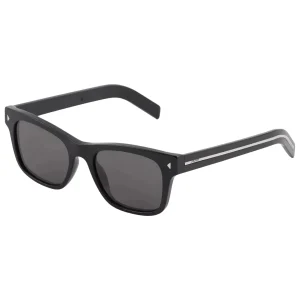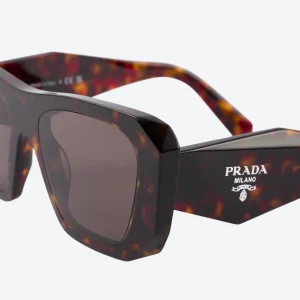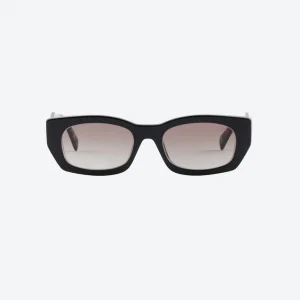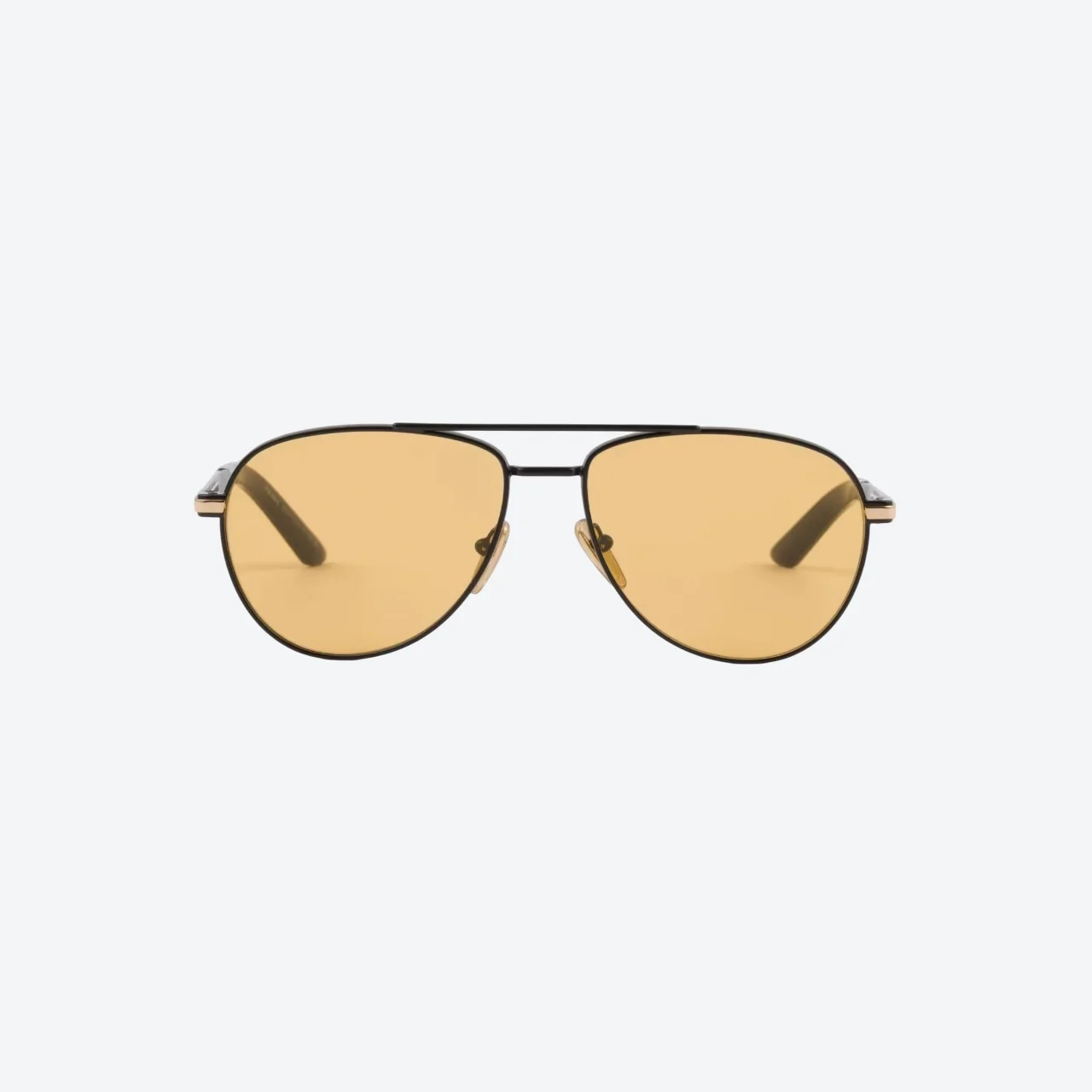
If you love how they look, keep them — but go in clear-eyed. At $433, Prada sunglasses are made by Luxottica, the same factory that makes your $111 Ray-Ban, using comparable acetate and often non-polarized lenses. You’re paying roughly $250 for design, fit, and the logo, not for superior optics. That’s not automatically a rip-off — face fit and styling are real value — but if you expected $433 of lens technology, it isn’t there. The frame and the look are what justify it.
What $433 Prada Retail Actually Buys (vs $111 Ray-Ban)
Break the $433 down. You get a frame in Mazzucchelli Italian acetate (or metal, depending on model), mineral glass or CR-39 lenses with 100% UV protection, a Prada hard case, microfiber, and authenticity card. A model like the PR 17WS (cat-eye, ~51-18-140, 28–32g) is genuinely well-built acetate.
A $111 Ray-Ban — say a discounted Wayfarer or Hexagon — gives you injection-molded propionate or a metal frame, polycarbonate or basic glass lenses, the same 100% UV, and a softer case. Build-wise the Ray-Ban is a tier down in material density, but it’s not four times worse.
The honest math: the actual manufacturing cost of either pair sits around $20–$40. The gap between $111 and $433 is brand positioning, retail margin, and licensing — not $322 of extra glass and acetate. You’re buying a nicer frame and a luxury name, and paying a steep multiple for the privilege.
Luxottica Makes Both — Why You’re Paying for the Logo
Here’s the part that stings: EssilorLuxottica owns Ray-Ban outright and manufactures Prada under license. The same Italian factories, the same hinge suppliers, the same lens lines produce both. Oakley, Persol, Versace, Chanel, and Dolce & Gabbana run through the same group.
So the Prada and the Ray-Ban on the shelf next to each other share a corporate parent and overlapping parts bins. The hinges, screws, and lens coatings can be near-identical components. What differs is the frame design, the acetate grade, and the logo plate — plus the licensing fee Luxottica pays the Prada fashion house, which gets baked into your price.
That’s why a Prada costs 3–4x a Ray-Ban despite shared DNA. You’re funding the Prada brand royalty and the luxury-tier margin. None of this makes Prada bad — the design and acetate are real — but understand that “Prada quality” and “Ray-Ban quality” come off related production lines. The premium is the name and the styling, paid in full at $433.
Non-Polarized Lenses at Full Retail — The Hidden Bad Deal
This is the worst-value detail buyers miss. Many Prada sunglasses at full $433 retail ship non-polarized. Polarization — the coating that kills horizontal glare off roads, water, and car hoods — is a paid upgrade or limited to specific SKUs, adding $40–$70.
Compare that to Maui Jim, where every pair is polarized with multi-layer glare and color-enhancing tech, starting around $200–$250. So a $230 Maui Jim out-performs a $433 Prada on actual lens function for half the money. You’re paying luxury price for base-tier optics.
Check the lens before you buy: polarized Prada is marked “Polarized” on the right lens and inner temple. If yours isn’t, you’ll squint through windshield glare no matter how dark the tint, and you paid $433 for the privilege. For pure street and casual wear, non-polarized glass is fine — color is actually truer. But for driving or water, a non-polarized $433 pair is the hidden bad deal in the catalog.
Return Traps — Why Sending Back Prada Costs You $222 on Ray-Ban
The Reddit dilemma is real: return the Prada and the Ray-Ban you’d swap to runs ~$222 at full price, erasing most of your “savings.” That’s the trap. If the Prada came with a discount, promo, or store credit you’d lose, the net difference between keeping Prada and buying full-price Ray-Ban can shrink to $100–$150 — not the $322 gap the sticker implies.
Run your actual numbers. If you paid $433 but a return only nets you back enough to buy a $222 Ray-Ban you like less, you’re spending $222 to downgrade the look you already love. The smarter move is often to keep the Prada if the fit is right and you’ll wear them for years, since 5+ years of daily use makes the per-wear cost trivial.
The genuinely cheaper path isn’t the full-price Ray-Ban swap — it’s buying the same Prada model used or past-season for $160–$220. That beats both the $433 keep and the $222 Ray-Ban downgrade.
Better Alternatives — Maui Jim, Persol, and Past-Season Prada
Three smarter buys if value matters. Maui Jim — every pair polarized, glass lenses with color-boosting coatings, $200–$280. Models like the Mavericks or Red Sands out-optic Prada for less, with a lighter ~25g feel. The trade-off is styling: Maui Jim reads sporty, not luxury-fashion.
Persol — also Luxottica, but the hand-finished, higher-craft sibling. The 649 and 714 (folding) Steve McQueen lines use Meflecto flex hinges and crystal glass lenses at $280–$400. You get genuinely superior construction to Prada at a similar or lower price, with a heritage look.
Past-season Prada itself — last year’s PR 17WS or PR 18WS drops to $160–$220 on eBay, Fashionphile, or outlet channels once the new collection lands. Same frame, same glass, same logo — minus the current-season tax. For the exact look the Reddit buyer loves, this is the move: keep the Prada aesthetic, skip $200+ of retail markup. Verify authenticity (temple code, frosted lens etch, 28–32g weight) before paying.
Pairing $400 Prada Frames With Hellstar Streetwear Fits
If you’re keeping them, style them so the cost reads intentional. Prada acetate frames anchor a Hellstar Studios fit — the oversized flame-graphic or “moon man” hoodie, baggy distressed denim, the washed dystopian palette. The luxury frame against grungy streetwear is the whole high/low tension that makes the look land.
Go black or smoke acetate for versatility; a PR 17WS cat-eye or a squarer PR 18WS both sit clean under a Hellstar hood. The polished frame keeps an intentionally sloppy fit from tipping into careless — sunglasses are the detail that signals you spent money on purpose.
For fit pics, mirror-tint lenses pop on camera; for daily wear, neutral glass reads truer. Pair them with clean rotation pieces — Hellstar gel-print tees from the 2023–2024 drops, simple chrome jewelry — and the $400 frame earns its place as the anchor of the outfit instead of a flex nobody asked about. Worn right, the Prada elevates the streetwear; worn wrong, it just looks like you’re trying.
FAQ
Q: Is $433 full retail for Prada sunglasses outrageous?
A: It’s steep but standard for current-season luxury eyewear. Manufacturing costs around $20–$40; the rest is brand royalty and retail margin. Not outrageous if you value the design and fit, but you’re paying a 3–4x multiple over comparable Luxottica-made Ray-Bans.
Q: Should I keep Prada if I love how they look but hate the price?
A: Keep them if the fit is right and you’ll wear them for years — per-wear cost drops fast. Or buy the same model past-season for $160–$220 used. Don’t swap to a $222 Ray-Ban you like less just to “save.”
Q: Are Ray-Ban hexagon frames still trendy in 2026?
A: Yes, the Hexagon stays a steady seller, but it reads more classic-retro than cutting-edge streetwear. For Hellstar and current street fits, bold acetate shapes like Prada’s cat-eye or square frames feel more current than the thin metal hexagon.
Q: Where do people find Prada sunglasses for $160 instead of $433?
A: Past-season and used pairs on eBay, Fashionphile, and outlet channels run $160–$220 for the same PR 17WS or PR 18WS. Verify authenticity — temple code, frosted lens etch, 28–32g weight, glass lenses — before paying to avoid reps priced near genuine used.