Check the lens etching, the temple stamp, and the weight — in that order. Genuine Prada sunglasses carry a laser-etched logo on the right lens (PRADA on non-polarized, PRZ on polarized pairs), a clean model code inside the left temple like SPR 17W 1AB-5S0 51□18 140, and real Italian acetate that feels dense and cold. The single biggest myth: the PRZ mark only appears on polarized lenses, so its absence on a standard pair is not a fake — it’s expected.
PRADA vs PRZ Lens Etching — Polarized Only Confusion
This trips up more buyers than anything else. Prada laser-etches a small logo into the top-right corner of the right lens, visible when you tilt it under light. On non-polarized lenses that etch reads PRADA. On polarized lenses it reads PRZ — Prada’s polarized lens code.
So when someone online screams “fake, there’s no PRZ!” on a standard pair, they’re wrong. PRZ only exists on polarized models. A non-polarized PR 17WS will show “PRADA” and nothing more, and that’s 100% correct. Demanding PRZ on every lens is the Reddit confusion you’ll see repeated constantly.
The etch itself is the tell, not the wording. Genuine laser etching is crisp, shallow, and frosted-looking, sitting inside the coating without scratching through it. Fakes either skip the etch, print it in ink that wipes off, or cut it so deep it catches a fingernail. Tilt the lens 30–45 degrees toward a window; real etching ghosts in and out as the angle changes. If it’s bold from every angle or smears under a thumb, it’s reproduced.
Nose Pad Stamps and Temple Arm Model Codes
Two stamps confirm a real pair. First, the metal nose pads (on frames that have them) carry a tiny embossed “PRADA” — raised, evenly spaced, centered on the pad. Fakes leave pads blank, stamp them off-center, or use a thinner font that fills with grime. Run a fingernail over it; genuine lettering has clean raised edges.
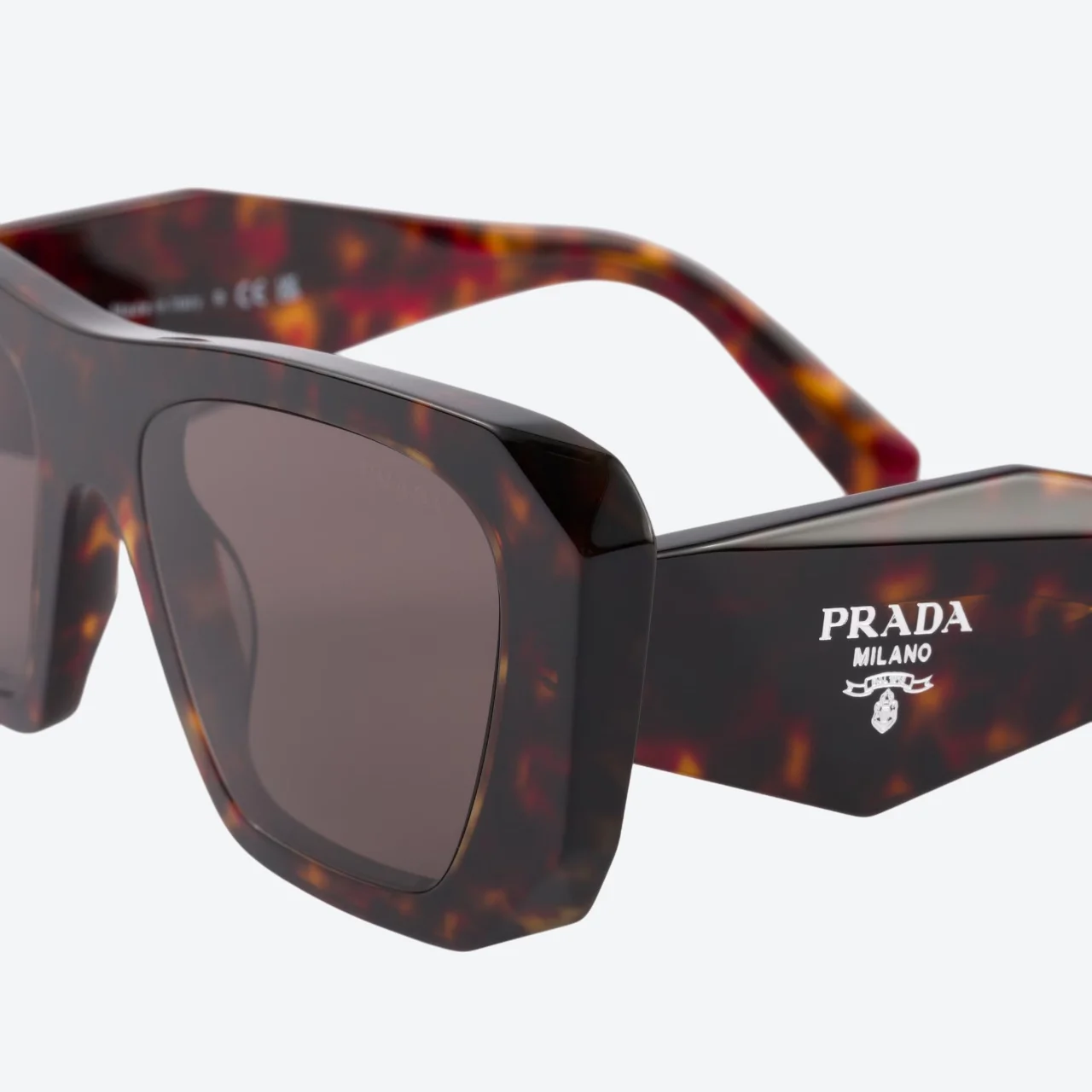
Second, and more important, the inside of the left temple arm holds the full code: model number, color code, and measurements, like SPR 17W 1AB-5S0 51□18 140. Break it down — SPR 17W is the model, 1AB-5S0 is frame-and-lens color, 51□18 is lens width and bridge width in mm (the box is the bridge symbol), 140 is temple length. The right temple carries “Made in Italy,” CE, and a serial-style string.
Genuine printing is sharp white, perfectly aligned to the arm, and survives light rubbing because it’s heat-set. Fakes smudge, misalign, or misspell. A real 2021-era PR 17WS measures exactly 51-18-140 — if the listing photo shows different numbers than the model claims, walk.
Weight, Hinge Feel, and Acetate Build Quality Tells
Pick it up. A genuine PR 17WS weighs roughly 28–32 grams because of Mazzucchelli Italian acetate and mineral glass lenses. Fakes run injection-molded plastic and polycarbonate, landing 18–24 grams — noticeably lighter and warmer to the touch. Real acetate feels cold and dense against your cheek; cheap plastic feels warm and hollow.
The hinges are the next tell. Genuine Prada uses 3-barrel or 5-barrel metal hinges with smooth, weighted resistance — the arm swings open and holds at any angle without flopping or grinding. Fake hinges are loose, click sharply, or snap fully open with no in-between tension.
Look at the acetate edges under light. Real frames are hand-polished with rounded, glassy edges and no visible mold seams. Counterfeits show a faint seam line along the top of the frame or temple where the mold halves met, plus slightly cloudy or matte spots the polishing missed. Tap a lens against your tooth — mineral glass gives a hard, high “tick,” polycarbonate gives a dull “tock.” These physical tells beat any photo check.
Craigslist and eBay Buys — Red Flags Before You Pay
Both platforms hide fakes among real deals. Authentic used PR 17WS runs $140–$220; anything listed “brand new” at $50–$70 is a rep, full stop — no exceptions at that price.
Run this checklist before sending money:
- Stock photos instead of real ones. Demand actual shots of the lens etch, both temple stamps, and the nose pads. A seller who won’t photograph the inner temple is hiding a missing code.
- No box, case, or card. Genuine ships in a Prada hard case with a branded microfiber and a paper authenticity card with a barcode matching the temple stamp.
- Vague model name. A real seller knows it’s a “PR 17WS,” not “Prada cat-eye black.”
- Pressure to go off-platform. On eBay, paying via Zelle or Venmo kills your buyer protection — the scammer’s whole goal.
On Craigslist, meet in person, bring this list, and inspect the etch and weight before cash changes hands. If they rush you or won’t let you handle it, leave.
Sunglass Hut Verification and What Staff Can Confirm
Sunglass Hut is Luxottica-owned, the same parent that manufactures Prada eyewear under license — so a pair bought there is authentic by definition. For a pre-owned pair you’re considering, staff can help, but know the limits.
What they can do: compare your frame against a current genuine PR 17WS in-store, check that your temple code matches a real model in their catalog system, and confirm the measurements and color code are a real combination. They’ll spot an obviously wrong font or seam instantly because they handle the real thing daily.
What they cannot do: run a serial number to prove your specific unit’s history, or issue an official “certificate of authenticity” for a pair you didn’t buy from them. Luxottica doesn’t offer public serial lookups, so a temple code only proves the combination exists, not that your frame is the genuine one wearing it.
For a paid verification, a third-party authentication service like Entrupy or a reseller such as Fashionphile ($20–$50) examines it under magnification and stands behind a written result — worth it before a $200+ used buy.
Rep vs Retail Prada — What Fakes Get Right in 2026
Replica quality jumped. A 2026-era 1:1 PR 17WS rep runs $25–$60 and nails the shape, acetate color, and even a convincing temple-code print — the days of obvious typos are mostly gone on top-batch fakes from Weidian and Taobao sellers.
What reps still miss: mineral glass lenses (they use polycarbonate, so the tooth-tap and weight give it away), correct hinge tension (rep hinges flop or grind), and the frosted laser etch (fakes print or over-cut it). The nose pad stamp is often slightly shallow or off-center because that micro-detail is hard to tool.
The hardest fakes to catch copy a real temple code, so the code matching online means nothing on its own — that’s the trap. Stack your checks: code plus glass lenses plus 28–32g weight plus frosted etch plus seamless polished edges. A rep fails at least two of those. Any single point passing doesn’t clear it; authentication is the whole stack agreeing.
FAQ
Q: Does every real Prada lens have PRZ etched on it?
A: No. PRZ only appears on polarized Prada lenses. Non-polarized pairs are etched “PRADA” instead. The absence of PRZ on a standard pair is correct, not a fake — demanding PRZ on every lens is a common authentication mistake.
Q: Where should PRADA be stamped on genuine frames?
A: On the metal nose pads as raised embossed lettering, on the right lens as a frosted laser etch, and the full model code inside the left temple arm. The right temple shows “Made in Italy,” CE, and a serial string. All printing is sharp and aligned.
Q: Can I trust a matching temple code on Google?
A: Only partly. A matching code proves the model-and-color combination is real, not that your specific frame is genuine — top-tier fakes copy real codes. Always pair the code check with glass lenses, correct weight, hinge feel, and a frosted lens etch.
Q: Are pre-owned Craigslist Prada sunglasses worth the risk?
A: Yes, if you inspect in person. Authentic used PR 17WS runs $140–$220, a real saving over $370 retail. Bring a checklist, verify the etch, weight, and stamps before paying cash, and walk if the seller rushes you or only shows stock photos.